
If you have been learning SEO, you probably already know about on-page SEO — optimising your content, using the right keywords, fixing your title tags. But here’s the truth: on-page SEO alone is not enough to rank on page one of Google.
That’s where off page SEO techniques come in.
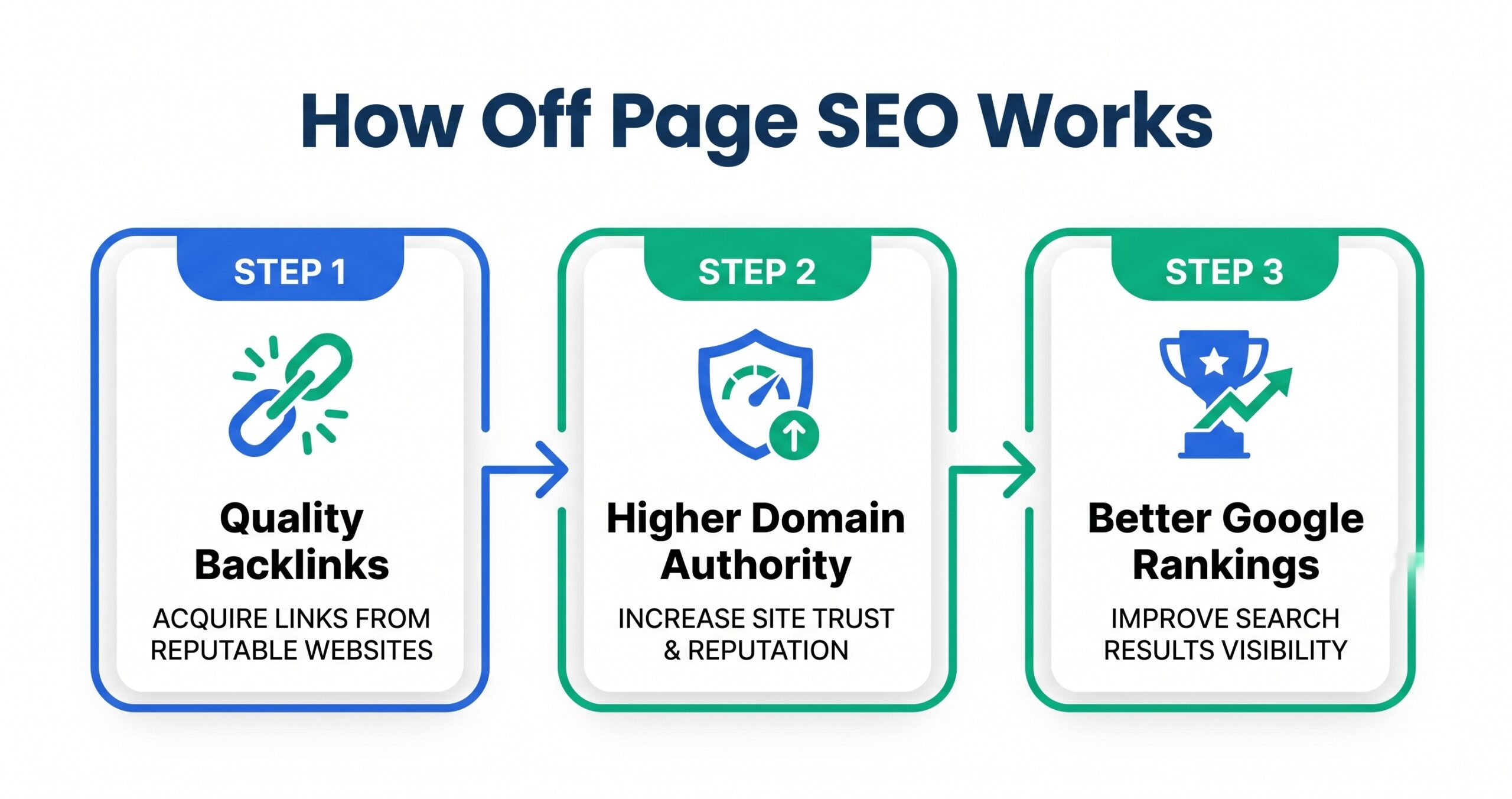
Off page SEO is everything you do outside your website to tell Google: “Hey, this site is trustworthy and authoritative.” It is the invisible hand that pushes your pages higher in search results — and without it, even the best content can sit unnoticed on page 4.
In this guide, I will walk you through 10 proven off page SEO strategies that actually work in 2026 — no shady tricks, no black-hat shortcuts — just methods that follow Google’s guidelines and build long-term authority.
Let’s get started.
What Is Off Page SEO?
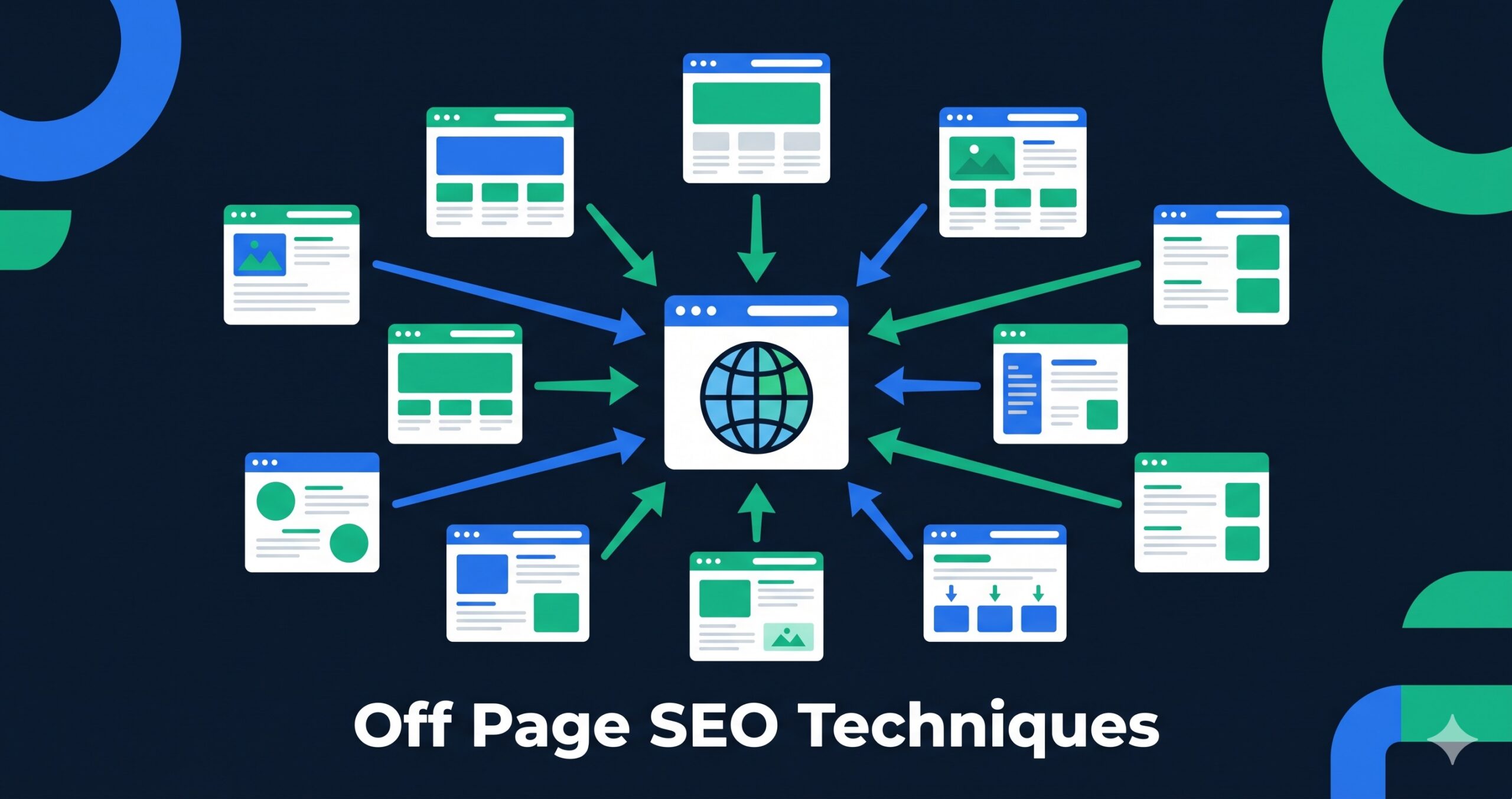
Off page SEO refers to all the actions taken outside of your own website to improve its position in search engine results pages (SERPs).
While on-page SEO focuses on the content and HTML structure within your website, off page SEO is about building your website’s reputation, authority, and trustworthiness in the eyes of Google and other search engines.
Think of it this way:
Your website is like a restaurant. On-page SEO is the quality of your food and ambiance. Off page SEO is the reviews people leave about you, the word-of-mouth recommendations, and the food bloggers who mention you.
Google uses these external signals — especially backlinks — to determine how credible and relevant your site is for a given topic.
Why Off Page SEO Matters for Your Rankings
Google has confirmed that links are one of the top 3 ranking factors. Here’s what off page SEO does for you:
- Increases Domain Authority (DA) — The more quality sites link to you, the more trustworthy Google considers your domain.
- Drives Referral Traffic — People click backlinks and land on your site directly
- Improves Crawl Frequency — Google crawls sites that are linked to frequently, more often
- Boosts Brand Awareness — Mentions across the web increase your brand’s visibility
- Helps New Content Rank Faster — A site with high authority ranks new content much quicker
On Page SEO vs Off Page SEO: What’s the Difference?
| Factor | On Page SEO | Off Page SEO |
|---|---|---|
| Location | Inside your website | Outside your website |
| Examples | Title tags, content, internal links | Backlinks, brand mentions, social signals |
| Control | You control it fully | Partially in your control |
| Focus | Content quality & relevance | Authority & trustworthiness |
| Tools | Yoast SEO, RankMath | Ahrefs, Moz, Semrush |
Both work together. A site with great on-page SEO but zero off-page signals will struggle to rank. A site with tons of backlinks but poor content won’t convert. You need both.
Already read about On-Page SEO? Check out our On Page SEO Checklist for Beginners.
10 Powerful Off Page SEO Techniques to Build Authority
1. Link Building: The Foundation of Off Page SEO
Link building is the process of getting other websites to link back to your website. These incoming links are called backlinks.
Google treats backlinks like votes of confidence. When a high-authority website links to yours, it’s essentially saying: “We trust this content enough to point our readers to it.”
Types of link building methods:
- Outreach-based — Contacting website owners and asking for links
- Content-based — Creating content so valuable that people link to it naturally
- Relationship-based — Building connections in your niche
Quick Tip: Focus on quality over quantity. One backlink from a reputable site like Moz or HubSpot is worth more than 50 backlinks from unknown blogs.
2. Guest Posting on Authority Websites
Guest posting means writing an article for another website in your niche — and in return, you get a backlink to your site, usually in the author bio or within the content.
How to do it:
- Search Google for: “write for us” + SEO or “guest post” + digital marketing
- Find websites with a Domain Authority (DA) of 30 or above
- Pitch a unique topic idea they haven’t covered
- Write a high-quality article — treat it like your best work
- Include a natural backlink to a relevant page on your site
Important: Avoid guest posting on spammy, low-quality sites. Google penalises unnatural link schemes.
3. Broken Link Building
This is one of the smartest — and most underused — off page SEO techniques.
How it works:
- Find a website in your niche that has a broken link (a link pointing to a page that no longer exists — a 404 error)
- Create content on your site that covers the same topic as the broken link
- Email the website owner and let them know their link is broken
- Suggest your content as a replacement
Everyone wins — they fix their broken link, you get a backlink.
Tool to use: Install the Check My Links Chrome extension to find broken links on any webpage instantly.
4. Digital PR and Brand Mentions
Digital PR is about getting your brand mentioned in online publications, news sites, and industry blogs — with or without a direct link.
Even unlinked brand mentions (where someone mentions your site by name without linking to it) are a positive signal for Google. But obviously, linked mentions are better.
How to get brand mentions:
- Write original research or surveys and share the data
- Create free tools, templates, or resources people want to reference
- Respond to journalist queries using HARO (Help a Reporter Out) — now called Connectively
- Publish a strong opinion piece or case study
5. Social Media Signals
While social media links are mostly nofollow (they don’t pass direct link equity to Google), social media still plays an important indirect role in SEO.
Here’s why it matters:
- Posts that get shared widely drive traffic to your content
- More traffic signals to Google that your content is valuable
- Social media helps your content get discovered by bloggers and journalists who may then link to it
Best platforms for SEO-supporting social signals:
- LinkedIn — Great for B2B and professional content
- Twitter/X — Fast content discovery and industry conversations
- Pinterest — Excellent for blog content with strong visuals
- Quora — See the next point
6. Forum Participation and Q&A Sites
Participating in forums like Reddit and answering questions on Quora is a legitimate off page SEO technique that:
- Builds your topical authority
- Drives referral traffic to your site
- Creates a natural link footprint
How to do it right:
- Search for questions related to SEO, digital marketing, content strategy, etc.
- Write a genuinely helpful, detailed answer
- Where relevant and natural, link to one of your blog posts for more information
- Do NOT spam links — Quora bans accounts that do this
Pro tip: Quora answers can rank on Google on their own. A great Quora answer to “What are the best off page SEO techniques?” that links to your article is golden.
7. Business Directory Submissions
Submitting your website to trusted online directories helps build local SEO authority and referral traffic. This is especially useful if your site serves a local or regional audience.
Top directories to submit to:
- Google Business Profile (most important — do this first)
- Bing Places for Business
- Justdial (for Indian businesses)
- Sulekha
- IndiaMART (if applicable)
For a pure content/blog site like LearningSeohub.in, focus on directories for education sites and digital marketing resources.
8. Skyscraper Technique
The Skyscraper Technique was popularised by SEO expert Brian Dean of Backlinko. Here’s the concept:
- Find content in your niche that already has a lot of backlinks
- Create a better version — more up-to-date, more detailed, better designed
- Reach out to everyone linking to the original and show them your improved version
Example:
- Find the most-linked article on “keyword research for beginners”
- Write a deeper, more current version with examples, visuals, and a downloadable checklist
- Outreach to sites that link to the old article
This technique works because you’re not starting from zero — you already know people want to link to that type of content.
9. Influencer Outreach
Building relationships with influencers and bloggers in the SEO/digital marketing niche can get your content shared with their audiences and earn you natural backlinks.
How to start:
- Follow and engage genuinely with SEO bloggers on Twitter, LinkedIn
- Share their content and leave thoughtful comments
- Mention them in your articles (“As Ahrefs explains in their backlink guide…”)
- Then reach out to let them know — they may share it or link back
This takes time, but the relationships you build pay dividends for years.
10. Resource Page Link Building
Many websites maintain “Resources” or “Useful Links” pages where they list helpful tools, articles, and guides for their audience.
How to get on them:
- Search Google: “SEO resources” intitle:resources or “digital marketing links” inurl:resources
- Find resource pages relevant to your niche
- Check if your content would genuinely add value
- Email the site owner with a polite, specific pitch
This is low-competition and high-reward, especially for beginner SEO blogs.
What Makes a High-Quality Backlink?
Not all backlinks are equal. Here’s what separates a powerful backlink from a useless (or harmful) one:
| Factor | Good Backlink | Bad Backlink |
|---|---|---|
| Source Authority | High DA/DR website | Low-quality, spammy site |
| Relevance | Same or related niche | Completely unrelated |
| Link Placement | Within the main content | Footer or sidebar |
| Link Type | Dofollow | Nofollow (less valuable) |
| Anchor Text | Natural and relevant | Over-optimised / exact match spam |
Dofollow vs Nofollow Links: Which One Matters?
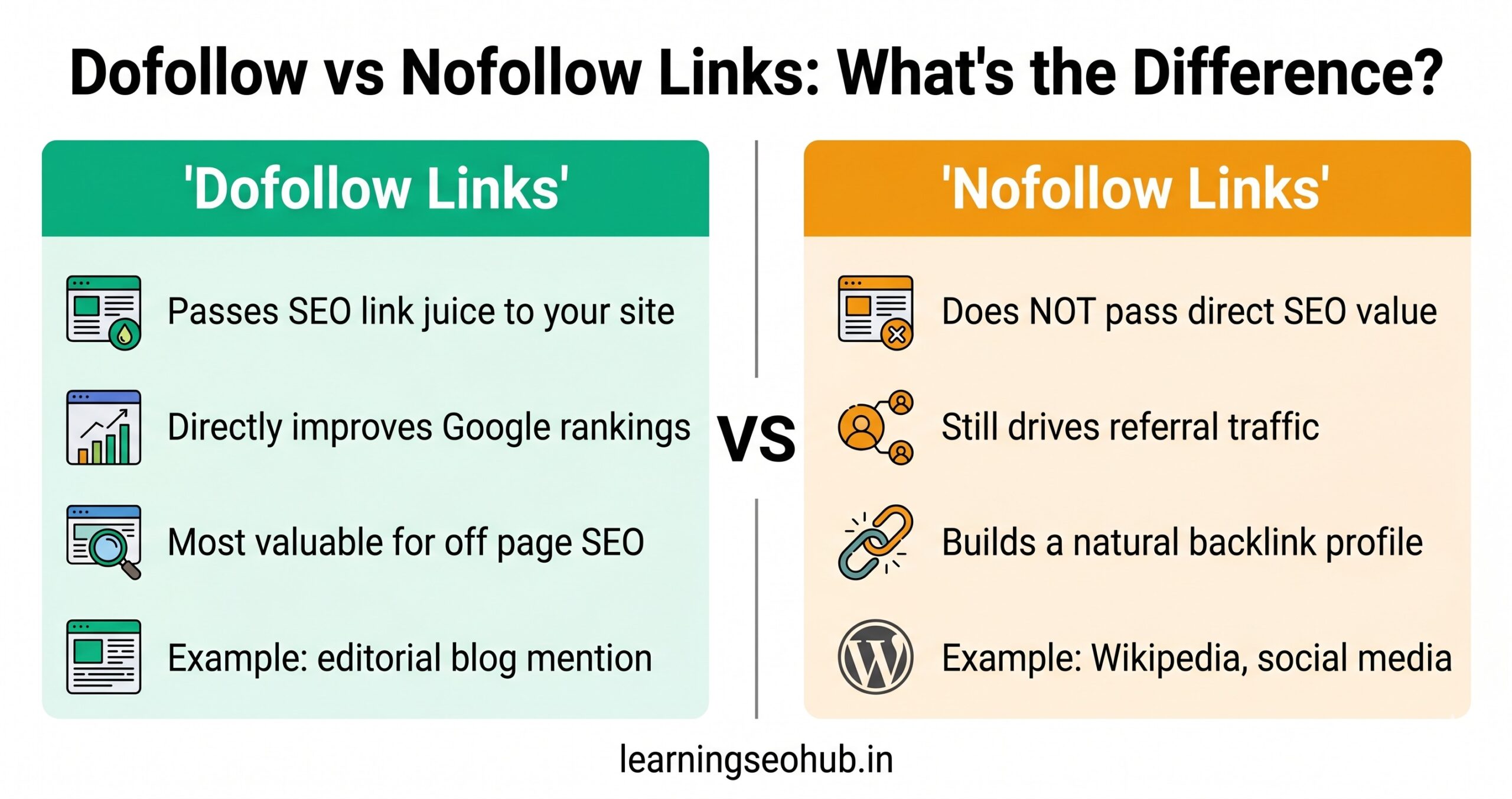
- Dofollow links — Pass “link juice” (SEO equity) from one site to yours. These directly help your rankings.
- Nofollow links — Tell Google not to pass SEO value. Added using rel=”nofollow”. Most social media and Wikipedia links are nofollow.
Do nofollow links matter?
Yes — they still drive traffic and create a natural-looking backlink profile. An entirely dofollow backlink profile looks unnatural and can trigger a Google penalty. Aim for a healthy mix.
Anchor Text: How to Use It Correctly
Anchor text is the clickable text used in a hyperlink. Example: [off page SEO techniques] — here, “off page SEO techniques” is the anchor text.
Anchor text best practices:
- Branded — “Learning SEO Hub” → Safest and most natural
- Partial match — “check these off page SEO tips” → Good
- Exact match — “off page SEO techniques” → Use sparingly (5–10% max)
- Generic — “click here”, “read more” → Avoid when possible
Over-optimising anchor text is a known Google penalty trigger (Penguin algorithm).
Off Page SEO Checklist for 2026
Use this checklist every month to track your off page SEO progress:
Link Building
- Identified 5 link-building opportunities this month
- Sent outreach emails for guest posting
- Found and reported broken links to site owners
Content & PR
- Published content that’s worth linking to (data, tools, guides)
- Responded to 2–3 HARO/Connectively queries
- Got at least one brand mention this month
Social & Community
- Shared new content on LinkedIn, Twitter/X
- Answered 3–5 questions on Quora or Reddit
- Engaged with 5 bloggers/influencers in my niche
Technical Monitoring
- Checked new backlinks in Google Search Console
- Identified and disavowed any toxic/spammy backlinks
- Tracked Domain Rating (DR) using Ahrefs or Moz Free
Common Off Page SEO Mistakes to Avoid
❌ Buying backlinks — Google’s algorithms detect paid link schemes and penalise heavily
❌ Using Private Blog Networks (PBNs) — A high-risk black-hat tactic that can result in deindexing
❌ Submitting to link farms — Mass directory submissions to low-quality sites
❌ Ignoring anchor text diversity — Too many exact-match anchors triggers Penguin penalty
❌ Chasing quantity over quality — 1,000 spammy links hurt more than they help
❌ Ignoring Google Search Console — Always monitor who’s linking to you
Frequently Asked Questions
Q: How long does off page SEO take to show results?
A: Off page SEO is a long-term strategy. You may start seeing improvements in 3–6 months, but significant ranking changes typically take 6–12 months of consistent effort.
Q: How many backlinks do I need to rank on page 1?
A: There’s no fixed number. It depends on the competition for your target keyword. Use tools like Ahrefs or Ubersuggest to check how many referring domains the top-ranking pages have.
Q: Is off page SEO the same as link building?
A: Link building is the biggest component of off page SEO, but off page SEO also includes brand mentions, social signals, reviews, and digital PR.
Q: Can I do off page SEO for free?
A: Absolutely. Guest posting, Quora answers, forum participation, and broken link building can all be done for free — they just require time and effort.
Q: What tools should I use for off page SEO?
A: Google Search Console (free), Ahrefs (paid), Moz (free + paid), Ubersuggest (freemium), and Hunter.io for outreach emails.
Want to know the best SEO tools? Read our guide: 11 Best SEO Tools for 2026
Final Thoughts
Off page SEO is not a one-time task — it’s an ongoing process of building relationships, creating link-worthy content, and earning trust from both Google and real people across the web.
Start small:
- Pick 2–3 techniques from this list
- Be consistent for 90 days
- Track your backlinks in Google Search Console
- Gradually expand your strategy
Your website’s authority won’t grow overnight — but with a solid off page SEO strategy, every article you publish will rank faster and higher than the last.
Got questions about off page SEO? Drop them in the comments below! 👇
Related Articles: